
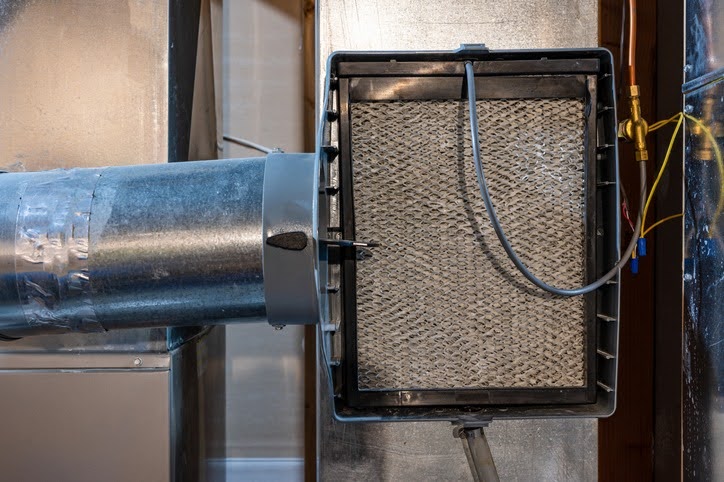
At Residential Heating & Cooling, we’ve been helping Chicagoland families improve their indoor air quality since 2009. We believe whole-house humidifiers are some of the most useful tools anyone could use to enhance their indoor air quality. Below, we’ll pull back the curtain on the technology to answer the big question: how do whole-house humidifiers work, and which type is right for your home?
At a Glance: Comparing Whole-Home Humidifier Systems
| Feature | Bypass Humidifiers | Fan-Powered Humidifiers | Steam Humidifiers |
| How it Works | Use the pressure of your furnace’s blower to push air through a water-soaked pad. | Uses its own internal fan to pull air across the pad, regardless of furnace speed. | Electrically heats water to a boil and injects pure steam directly into your ducts. |
| Airflow Needs | Only works when the furnace is actively blowing hot air. | Can operate even when the furnace is in a lower-speed or “fan-only” mode. | Operates independently of the furnace, providing the most consistent humidity. |
| Best For | Budget-friendly installs in small to mid-sized homes (under 3,000 sq. ft). | Larger homes or tight utility closets where there isn’t room for a “bypass” duct. | High-end custom homes, luxury hardwood floors, and homeowners with severe allergies. |
| Maintenance | Requires a simple replacement of the evaporator pad once per season. | Requires a seasonal pad change and an occasional check of the internal fan motor. | Requires periodic replacement of the steam canister and mineral cleaning. |
| Moisture Output | Moderate: Relies on natural evaporation from the warmth of your furnace. | High: The internal fan accelerates the evaporation process for faster results. | Maximum: Injects actual moisture into the air, reaching your target humidity levels fast. |
Do Whole House Humidifiers Work?
In a word: Yes. Unlike portable units that only humidify the area immediately surrounding them and require constant refilling, a whole-home system is a “set-it-and-forget-it” solution. It integrates directly with your furnace to treat all of your home’s air at the same time.
By maintaining a consistent humidity level (ideally between 35% and 50%), these systems protect your respiratory health, prevent hardwood floors from shrinking, and can even save you money on heating, since air that’s more humid feels warmer than dry air of the same temperature.
What Are the 3 Types of Whole-House Humidifiers and How Do They Work?
A whole-home humidifier is essentially a “passenger” on your HVAC system. It doesn’t have its own ductwork; instead, it uses the air your furnace is already moving to distribute moisture throughout every room in your home. Depending on your home’s size and your specific comfort needs, we typically install one of the following three types.
Bypass Humidifiers
This is the most common residential whole-house humidifier installation because it is simple, reliable, and cost-effective. It works by creating a small “bypass” loop between your supply and return air ducts.
When your thermostat detects that the air is too dry, it opens a solenoid valve to trickle water over a porous evaporator pad. Because of the natural pressure difference between your supply and return ducts, air is forced through that wet pad, picking up moisture through evaporation before being carried out through your vents.
Fan-Powered Humidifiers
While these look similar to bypass models, fan-powered humidifiers contain their own internal motor and fan. Instead of relying purely on the furnace’s air pressure to push air through your humidifier’s water panel, this unit’s fan actively pulls air across it. This design is significantly more efficient for larger homes and allows the unit to provide humidity more effectively, even when the furnace is running on a lower-speed or “fan-only” cycle.
Steam Humidifiers
Steam humidifiers are considered the “gold standard” for precision control because they don’t rely on the furnace’s heat for evaporation. Instead, these units feature an internal canister that boils water, creating steam to be injected directly into your ductwork. These systems are perfect for homes with high-end hardwood floors, grand pianos, or extensive custom woodwork because they’re fast and precisely controlled.
Signs a Whole-House Humidifier Isn’t Working Properly
Many homeowners reach out because they have a system, but they don’t feel any different. Because our water in the Northwest Suburbs is notoriously “hard,” mineral buildup is the #1 reason these systems stop working effectively.
If your home still feels dry despite running your whole-house humidifier, here are three ways to check if your unit is functioning properly:
-
Check the Drain Line:
While your furnace is running and the humidistat is calling for moisture, you should see a small, steady trickle of water moving through the clear plastic drain line into your floor drain. If that line is dry, water isn’t reaching the evaporator pad.
-
Listen for the Solenoid “Click”:
Your humidifier uses an electric valve (a solenoid) to turn the water on and off. If you turn your humidistat all the way up, you should hear a faint click at the unit. No sound usually indicates an electrical issue or a seized valve.
-
Inspect the Water Panel:
Pop the cover off the unit (usually held by a few simple clips). If the honeycomb-like pad looks “crusty” or is covered in white mineral deposits, it can no longer evaporate water efficiently. In our region, these pads generally need to be replaced at least once per season.
Interested in a Whole-House Humidifier Now?
Understanding how a whole-house humidifier works is the first step toward a more comfortable home. If you’re tired of the static shocks and the dry-air itch, it’s time to move beyond the portable units.
Explore our Whole House Humidifier Solutions & Installation Services
 612 Albion Ave.